
Showing posts with label Vet Stuff. Show all posts
Showing posts with label Vet Stuff. Show all posts
Thursday, May 19, 2011

Saturday, February 26, 2011
Margo is NOT Pregnant!
So, Margo isn't bred! Woohoo! I can ride this year, yay! Here is a lovely picture Kara took of the vet lubing up her glove...
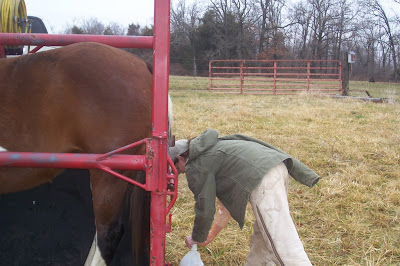 And here she is getting sleeved... eww....
 Me, watching and worrying... sigh... These are the vet's fancy portable stocks. Margo did NOT want to go into them. Four of us women tried bribing her with food, blindfolding her, pushing/pulling her, sidepassing her into them, backing her into them.... o_O
Well, we ended up having to tranq her, which cost me an extra $20 bucks, dang mare. Oh well, at least I know now that she is open. :)
 And here she is getting sleeved... eww....
 Me, watching and worrying... sigh... These are the vet's fancy portable stocks. Margo did NOT want to go into them. Four of us women tried bribing her with food, blindfolding her, pushing/pulling her, sidepassing her into them, backing her into them.... o_O
Well, we ended up having to tranq her, which cost me an extra $20 bucks, dang mare. Oh well, at least I know now that she is open. :)
Monday, January 11, 2010
Blood in the snow...
Sunday was not as nice as our Saturday night out... I went down to the barn Sunday morning and Margo had frozen blood all over her ear!  Hard to get a good pic... My poor baby! I left it alone, since it wasn't bleeding anymore, but tender. I went out in the field to try and figure out what happened and found a bunch of blood in the snow.
  Yikes! That is never fun to find! Looks like she was eating with her head through the damn barb wire fence and must have caught her ear on it. :(
 Hard to get a good pic... My poor baby! I left it alone, since it wasn't bleeding anymore, but tender. I went out in the field to try and figure out what happened and found a bunch of blood in the snow.
  Yikes! That is never fun to find! Looks like she was eating with her head through the damn barb wire fence and must have caught her ear on it. :(
Thursday, May 21, 2009
The Obese (or Just Fat) Horse Diet

Well, Margo isn't that fat! :) Almost though!
I got out the weight tape last night and here are my two's appx stats:
Margo: 15.1 hh, 1,190 lbs
Peter: 10.2 hh, 510 lbs
It is recommended to feed 1.5 to 2% of horse's body weight in roughage (hay) per day. For them to lose weight, you should feed for a goal weight you would like to reach (incrementally). So, I would like to get Margo to 1000 lbs 1st, so that would be about 15 lbs of hay per day. Pete, I would like to get him down to 480 lbs 1st, that would be appx 8 lbs of hay per day. I am not going to calculate in their time out grazing, since it is minimal.
I searched the internets for a horse diet, and found that it is like a human diet, you have to figure out what is best for you. I got slightly hysterical, but I think it was because I was reading too much into diets for horses who have already foundered. Mine have not foundered, they just need to lose weight.
So... Here is the best "Horse Diet" plan I could come up with (probably will be tweaked as needed):
Monday-Friday:
5 am - Dan lets horses out of paddock for morning grazing as he is leaving for work
6 am - I muck out paddock, set up morning hay (1 flake for Margo, 1/2 flake for Pete and "grain" 1 small handful for Pete, 1 large handful for Margo. (Both with salt and minerals) (Grain is actually low-fat grass hay pellets, it tricks them though!) Put both horses back in pen as I leave.
5 pm - Whoever gets home first gives horses 1 flake of hay to split.
6 or 7 pm - Turn out on grass for 1 to 2 hours, when they come back in, they get the "grain" handfuls again, with salt and minerals, and a small scoop of applesauce with MagOx mixed in it.
9 pm (or right before bed) - 2 flakes for Margo, one flake for Pete (broke apart and spread around paddock)
So, that is my plan for now. I want to add in either Farrier's Formula or SafeChoice as a supplement, so they are getting their daily requirements (minerals, vitamins, etc) in...
As for the good news...
Margo had withers this morning!!! She was so fat over her withers, it was like a squishy pillow, with no definition. This morning, her 'shoulder blades' were defined and distinguishable from her withers (spine) YAY!

She is still fat in other places, but she does not have a crease down her back, nor fat deposits over her eyes, so she wasn't/isn't obese, just chunky. :)
Thursday, May 14, 2009
Steps to Avoid Laminitis
Found online here Link
The management goals in preventing ‘grass’ founder should be observed from the start of spring or following late summer rains, when pastures are likely to grow rapidly and produce either fructan sugars (spring pastures), or high soluble carbohydrates that overload into the hindgut of grazing horses (autumn pastures).
1. Restrict access to lush spring pastures to 1 ½ hours in the early to mid-morning (after the dew has dried off) and again in the mid to late afternoon, as the peak production of fructan sugars in the leaves of the plant from sunlight photosynthesis occurs over the late morning to mid afternoon period.
2. Do not leave susceptible horses and ponies out to graze overnight during cool nights or on lush pasture.
Although the concentration of fructan sugars in the leaves decreases at night as they are transferred to the plant stems, horses and ponies often instinctively graze in the early evening and can take in large volumes of grass. Even if hay is offered in the evening to reduce the desire to graze, many horses and ponies will instinctively graze after consuming hard feeds and hay.
3. Always soak good quality grass hay, eg. grass and clover hay grown in early spring containing high levels of fructan sugars or soluble carbohydrates, for 1 hour in double its volume of lukewarm water. Remove and air dry and drain away the water. Do not add the soaking water to the feed. Ensure that the hay is free of mould or a “musty” smell for up to 60 minutes after soaking or until it is dry. A polywoven chaff bag is a suitable soaking bag to reduce leaf loss.
4. Offer chaff or ‘soaked’ hay before turning out to graze in the early morning or late afternoon to fill the stomach and limit the rate of fill when grazing as well as dilute the intake of fructan grasses.
5. Consider the daily use of Virginiamycin (Founderguard)® to suppress D-lactic acid producing bacteria and the cascade of damaging bacterial toxins during high risk periods, or a Foundermask to limit grazing.
6. Regular exercise in ‘cresty’ overweight ponies, that are insulin insensitive, can help reduce the risk of laminitis by utilizing more glucose on a daily basis.
7. Maintain short toes by ensuring the horses/ponies hooves are trimmed every 3-4 weeks so that there is less rotational force on the pedal bone on any devitalized laminae that are coping with the effects of circulating toxin. Long toes increase the deep flexor tendon downward rotation force on the pedal bone in standing animals, especially overweight horses with low heels as a result of chronic laminitis.
The management goals in preventing ‘grass’ founder should be observed from the start of spring or following late summer rains, when pastures are likely to grow rapidly and produce either fructan sugars (spring pastures), or high soluble carbohydrates that overload into the hindgut of grazing horses (autumn pastures).
1. Restrict access to lush spring pastures to 1 ½ hours in the early to mid-morning (after the dew has dried off) and again in the mid to late afternoon, as the peak production of fructan sugars in the leaves of the plant from sunlight photosynthesis occurs over the late morning to mid afternoon period.
2. Do not leave susceptible horses and ponies out to graze overnight during cool nights or on lush pasture.
Although the concentration of fructan sugars in the leaves decreases at night as they are transferred to the plant stems, horses and ponies often instinctively graze in the early evening and can take in large volumes of grass. Even if hay is offered in the evening to reduce the desire to graze, many horses and ponies will instinctively graze after consuming hard feeds and hay.
3. Always soak good quality grass hay, eg. grass and clover hay grown in early spring containing high levels of fructan sugars or soluble carbohydrates, for 1 hour in double its volume of lukewarm water. Remove and air dry and drain away the water. Do not add the soaking water to the feed. Ensure that the hay is free of mould or a “musty” smell for up to 60 minutes after soaking or until it is dry. A polywoven chaff bag is a suitable soaking bag to reduce leaf loss.
4. Offer chaff or ‘soaked’ hay before turning out to graze in the early morning or late afternoon to fill the stomach and limit the rate of fill when grazing as well as dilute the intake of fructan grasses.
5. Consider the daily use of Virginiamycin (Founderguard)® to suppress D-lactic acid producing bacteria and the cascade of damaging bacterial toxins during high risk periods, or a Foundermask to limit grazing.
6. Regular exercise in ‘cresty’ overweight ponies, that are insulin insensitive, can help reduce the risk of laminitis by utilizing more glucose on a daily basis.
7. Maintain short toes by ensuring the horses/ponies hooves are trimmed every 3-4 weeks so that there is less rotational force on the pedal bone on any devitalized laminae that are coping with the effects of circulating toxin. Long toes increase the deep flexor tendon downward rotation force on the pedal bone in standing animals, especially overweight horses with low heels as a result of chronic laminitis.
Diets, Blah!
 Fatties!
 Well, I started a diet, because I quit smoking and started eating all the time! I had to stop that or I was going to gain twenty pounds! :) Well, I have lost three pounds so far, and I cheated really bad last week! Ha! Oh well, at least I am not smoking! Two weeks today!
So, my farrier was out last night, to do Mags and Pete's feet. He said that they are both super freaking fat. He also said Margo has GAINED weight since the last time he was out. He claims that if I don't dry lot her ASAP, she is going to founder on me! GAH!
So, now her and Pete are going to have to live in the little pen (35'x50') between my barns (with the stall.) My farrier suggested they live in there 24/7, with one flake of hay in the am, and then turned out for one hour in the evening. He also strongly suggested that I lunge or ride Margo for at least 30 min everyday!
Why do I have to have such fatties?! Now I will have to start mucking the pen everyday too!
And, Daniel and I are going to HAVE to fix the fence around the pen. The section dividing the pen from the backyard is super loose barb wire. Dan said we can afford to do a board fence there, which is going to require the digging of 6 holes for posts, also the purchase of wood. (Anyone want to come out and help on Saturday?)
Poor me! :(
Why do they have to be SO fat??
I thought I was doing good to cut them down to just the 3/4 acre around the barn! I guess not. My farrier suggested I do this (keep them in pen, etc) until the next time he comes out (appx 6 wks) then he will help me decide where to go from there. Basically, Margo (and Pete) cannot be out on any grass until, probably, the end of summer... *sigh...
Tuesday, March 31, 2009
Christmas Kitty Will Survive...

He is really angry though, that we won't let him outside. Poor kitten.
I am having to give him an eye drop 4x a day, and a liquid antibiotic squirted in his mouth 2x a day. He LOVES that. Ha!
His poor little eye, it is all glazed over and the lids are so swollen they are pushing into his eye socket. Yuck. Daniel said he looks a 100x better than before he went to the vet though, so that is good.
I think Christmas is having problems with his depth perception and night vision. Last night he accidentally (or intentionally ?) knocked a cup of tea off our nightstand onto sleeping Daniel, and this morning he tried to jump on my nightstand and knocked off my two candles in a noisy crash... poor little guy...
In other news, Jim and Kristin's new baby, Sadie, is happy and healthy!
Also, Margo got a big cut on the top of her head last night... :) Fun!
Good Grief!
Monday, March 30, 2009
Oh Noes!!
Poor Christmas kitty!!

Christmas was out last night and apparently got in a nasty fight with someone (or something)!
Dan said he was curled up in a tight ball this morning and was unresponsive. He called me as soon as he saw Christmas's little eye! I guess he has a cut above his right eye, and the eye it self is swollen shut and basically a bloody-goopy mess. Poor kitten!
Daniel took him to Dake vet this morning; and the vet called me back a little bit ago. He had to put Christmas under to examine him. The vet said Christmas's eye is very inflamed, some damage to the eye itself and an infection is already present.
He said we can take him home and start him on a round of antibiotics, and two kinds of eye drops. The vet said, if these eye drops don't help, we can try two prescription-type drops that run $50 a tube! Yikes! I said we will try the ones he has and hope they work. I can't afford another $200+ vet bill!
If the eye doesn't heal, the vet said it may have to be removed! Poor Christmas! He might become a one-eyed pirate kitty! (I hope not!) The vet said the bad eye is responsive to light, but no where near as good as his good eye.
Thank God Daniel was home from work today! Poor Christmas kitten! He is going to go pick him up at 3:00. My poor baby!
*sniff *sniff

Christmas was out last night and apparently got in a nasty fight with someone (or something)!
Dan said he was curled up in a tight ball this morning and was unresponsive. He called me as soon as he saw Christmas's little eye! I guess he has a cut above his right eye, and the eye it self is swollen shut and basically a bloody-goopy mess. Poor kitten!
Daniel took him to Dake vet this morning; and the vet called me back a little bit ago. He had to put Christmas under to examine him. The vet said Christmas's eye is very inflamed, some damage to the eye itself and an infection is already present.
He said we can take him home and start him on a round of antibiotics, and two kinds of eye drops. The vet said, if these eye drops don't help, we can try two prescription-type drops that run $50 a tube! Yikes! I said we will try the ones he has and hope they work. I can't afford another $200+ vet bill!
If the eye doesn't heal, the vet said it may have to be removed! Poor Christmas! He might become a one-eyed pirate kitty! (I hope not!) The vet said the bad eye is responsive to light, but no where near as good as his good eye.
Thank God Daniel was home from work today! Poor Christmas kitten! He is going to go pick him up at 3:00. My poor baby!
*sniff *sniff
Thursday, March 19, 2009
Lutalyse (Lute) for Abortion in Horses
My mare was bred accidentally, when an ignorant neighbor's stud got on my property. I used Lutalyse to miscarrage my mare, by bringing her back into heat. Read through my other posts for results and more information. The following text is from the Lutalyse website.

LUTALYSE®
(dinoprost tromethamine)
Sterile Solution
Also known as DINOLYTIC™ Sterile Solution
and PRONALGON F™ Vet
Leading the World in Reproduction
LUTALYSE® (dinoprost tromethamine) Sterile Solution was the first natural estrus-synchronization product approved for horses, and it remains unsurpassed today. It makes breeding more convenient, especially when coordinating the use of stallions. LUTALYSE also helps mares with no clinical signs of cycling or irregular estrous cycles become pregnant.
Indications
LUTALYSE is indicated for its luteolytic effect in mares. It can be used in the following circumstances:
To control the time of estrus in estrous-cycling mares
Mares treated with LUTALYSE during diestrus (4 or more days after ovulation) will return to estrus within 2 to 4 days in most cases. They will ovulate 8 to 12 days after treatment. This procedure may be used as an aid to scheduling stallions.
To treat difficult-to-breed mares
In extended diestrus, there can be failure to exhibit a regular estrous cycle, which is different from true anestrus. Many mares described as anestrus during the breeding season actually have serum progesterone levels consistent with the presence of a functional corpus luteum. Treatment of such mares with LUTALYSE usually results in regression of the corpus luteum, followed by estrus and/or ovulation.
Key Features
LUTALYSE contains a well characterized prostaglandin. These compounds occur in nearly all mammalian tissue.
# The active ingredient in LUTALYSE contains the naturally occurring prostaglandin F2 alpha (dinoprost) as the tromethamine salt.
LUTALYSE was evaluated in 122 Standardbred and Thoroughbred mares that were in clinical anestrus for an average of 58 days and then treated with 5 mg of LUTALYSE during the breeding season. Behavioral estrus was detected in 81 percent of the mares at an average of 3.7 days after injection. Ovulation occurred an average of 7 days after treatment. During estrus, 59 percent of those mares bred were pregnant after an average of 1.4 services.
Packaging
LUTALYSE is available in 30-mL vials.
Dosage/Administration
1. Evaluate the reproductive status of the mare.
2. Administer a single intramuscular injection of 1 mg per 100 pounds of body weight (usually 1 mL to 2 mL of LUTALYSE Sterile Solution).
3. Observe mare for signs of estrus by means of daily teasing with a stallion. Evaluate follicular changes in the ovary by rectal palpation.
4. Some clinically anestrus mares will not express estrus, but they will develop a follicle that will ovulate. These mares may become pregnant if they are inseminated at the appropriate time relative to rupture of the follicle.
5. Breed mares in estrus in a manner consistent with normal management practices.
Precaution
LUTALYSE is ineffective when administered prior to day 5 after ovulation. The most frequently observed side effects were sweating and decreased rectal temperature, which were transient in all cases. Do not use in horses intended for food.
Despite treatment, anestrous mares that terminate pregnancy after 36 days may not return to estrus, due to the presence of functional endometrial cups.
Mares should not be treated if they suffer from either acute or subacute disorders of the vascular system, gastrointestinal tract, respiratory system or reproductive tract.
Federal law restricts this drug to use by or on the order of a licensed veterinarian.
When using LUTALYSE, as with all parenteral products, aseptic technique should be used to reduce the possibility of post-injection bacterial infections. Do not administer LUTALYSE in pregnant animals unless cessation of pregnancy is desired. Not for intravenous administration. Women of childbearing age and persons with respiratory problems should exercise extreme caution when handling LUTALYSE.

LUTALYSE®
(dinoprost tromethamine)
Sterile Solution
Also known as DINOLYTIC™ Sterile Solution
and PRONALGON F™ Vet
Leading the World in Reproduction
LUTALYSE® (dinoprost tromethamine) Sterile Solution was the first natural estrus-synchronization product approved for horses, and it remains unsurpassed today. It makes breeding more convenient, especially when coordinating the use of stallions. LUTALYSE also helps mares with no clinical signs of cycling or irregular estrous cycles become pregnant.
Indications
LUTALYSE is indicated for its luteolytic effect in mares. It can be used in the following circumstances:
To control the time of estrus in estrous-cycling mares
Mares treated with LUTALYSE during diestrus (4 or more days after ovulation) will return to estrus within 2 to 4 days in most cases. They will ovulate 8 to 12 days after treatment. This procedure may be used as an aid to scheduling stallions.
To treat difficult-to-breed mares
In extended diestrus, there can be failure to exhibit a regular estrous cycle, which is different from true anestrus. Many mares described as anestrus during the breeding season actually have serum progesterone levels consistent with the presence of a functional corpus luteum. Treatment of such mares with LUTALYSE usually results in regression of the corpus luteum, followed by estrus and/or ovulation.
Key Features
LUTALYSE contains a well characterized prostaglandin. These compounds occur in nearly all mammalian tissue.
# The active ingredient in LUTALYSE contains the naturally occurring prostaglandin F2 alpha (dinoprost) as the tromethamine salt.
LUTALYSE was evaluated in 122 Standardbred and Thoroughbred mares that were in clinical anestrus for an average of 58 days and then treated with 5 mg of LUTALYSE during the breeding season. Behavioral estrus was detected in 81 percent of the mares at an average of 3.7 days after injection. Ovulation occurred an average of 7 days after treatment. During estrus, 59 percent of those mares bred were pregnant after an average of 1.4 services.
Packaging
LUTALYSE is available in 30-mL vials.
Dosage/Administration
1. Evaluate the reproductive status of the mare.
2. Administer a single intramuscular injection of 1 mg per 100 pounds of body weight (usually 1 mL to 2 mL of LUTALYSE Sterile Solution).
3. Observe mare for signs of estrus by means of daily teasing with a stallion. Evaluate follicular changes in the ovary by rectal palpation.
4. Some clinically anestrus mares will not express estrus, but they will develop a follicle that will ovulate. These mares may become pregnant if they are inseminated at the appropriate time relative to rupture of the follicle.
5. Breed mares in estrus in a manner consistent with normal management practices.
Precaution
LUTALYSE is ineffective when administered prior to day 5 after ovulation. The most frequently observed side effects were sweating and decreased rectal temperature, which were transient in all cases. Do not use in horses intended for food.
Despite treatment, anestrous mares that terminate pregnancy after 36 days may not return to estrus, due to the presence of functional endometrial cups.
Mares should not be treated if they suffer from either acute or subacute disorders of the vascular system, gastrointestinal tract, respiratory system or reproductive tract.
Federal law restricts this drug to use by or on the order of a licensed veterinarian.
When using LUTALYSE, as with all parenteral products, aseptic technique should be used to reduce the possibility of post-injection bacterial infections. Do not administer LUTALYSE in pregnant animals unless cessation of pregnancy is desired. Not for intravenous administration. Women of childbearing age and persons with respiratory problems should exercise extreme caution when handling LUTALYSE.
Monday, December 15, 2008
Confirmed, Margo Has Mastitis! :(
My poor mare! After a stressful Friday, with Margo's udder swollen so big (and hot), I called my vet to see when they could fit her in to look at her. They only had open Saturday at 8:30 AM. (Of course!) Fair Grove Vet is an hour away from my farm, and I hate to rush, so Margo and I were on the road Saturday morning at 7 AM. (Yuck!)
So, the vet looked her over. She had a normal temperature (which is good!) and when the vet milked her infected udder, the fluid was clear to white, with no odor. (Pheww...) The vet said the last mare she had in with Mastitis had a 104 degree temp, and when she milked her bag it was green stinking pus that came out. So I caught it in time. (Hopefully!) Also, the vet checked her white blood cell count, and all was well there.
So, I was prescribed Banamine paste, for Margo's pain/tenderness.

Over $32 dollars a tube! Yikes! 1000 lb dose (day one) for Margo, and 500 lb doses the following days until the tube is empty.
My vet also had me put her on Tucoprim, which is an antibiotic.

This stuff was over $42 for the tub! Another Yikes! She is having me give Margo 2 scoops, twice a day until it is gone. Let me tell you, Margo HATES this stuff. The vet said to try and sprinkle it on her feed, but fat girl Margo only gets a tuna can of feed a day, and two scoops of this stuff is a lot! So, I am mixing the two scoops of Tucoprim with a bit of hot water and a big squirt of maple syrup in a giant dose syringe. I shake it until it is mixed, then shoot it in Margo's mouth. She hates it! This morning I had to about wrestle her to get it in her mouth. Fun!
Oh, and the most enjoyable part of the treatment is applying wet heat (in the form of a hot wash cloth) held up to her udder for ten minutes twice a day. Nothing quite as nice as leaning against Margo's fat belly while holding a wet wash cloth against her udder... (Ha!) Lucky though, that other than the Tucoprim stuff, Margo is a nice, polite patient.
After all this, the good news is, on Sunday, after only one round of meds, over 80% of her swelling is down with most of the heat gone! Woo-Hoo! I couldn't believe it! Today (Monday) her udder is the same as yesterday, but at least it hasn't swollen back up. And very little heat. (Big sigh of relief) So, I am not out of the clear with her yet, but I think we caught it early enough that it will clear up nicely. The vet said to call asap if the heat and swelling get worse, as apparently, in horses, if Mastitis isn't treated, it can be life threatening.
So, *fingers crossed* that it will continue to clear up and my mare will be fine!
Oh, the vet also said that Margo is a huge fat whale! (Which I know...) She said I need to basically starve her in a dry lot, with only 2 flakes of hay AM and PM. So, Daniel and I are finally forced to cross fence! More Fun! (More on that later...)
So, the vet looked her over. She had a normal temperature (which is good!) and when the vet milked her infected udder, the fluid was clear to white, with no odor. (Pheww...) The vet said the last mare she had in with Mastitis had a 104 degree temp, and when she milked her bag it was green stinking pus that came out. So I caught it in time. (Hopefully!) Also, the vet checked her white blood cell count, and all was well there.
So, I was prescribed Banamine paste, for Margo's pain/tenderness.

Over $32 dollars a tube! Yikes! 1000 lb dose (day one) for Margo, and 500 lb doses the following days until the tube is empty.
My vet also had me put her on Tucoprim, which is an antibiotic.

This stuff was over $42 for the tub! Another Yikes! She is having me give Margo 2 scoops, twice a day until it is gone. Let me tell you, Margo HATES this stuff. The vet said to try and sprinkle it on her feed, but fat girl Margo only gets a tuna can of feed a day, and two scoops of this stuff is a lot! So, I am mixing the two scoops of Tucoprim with a bit of hot water and a big squirt of maple syrup in a giant dose syringe. I shake it until it is mixed, then shoot it in Margo's mouth. She hates it! This morning I had to about wrestle her to get it in her mouth. Fun!
Oh, and the most enjoyable part of the treatment is applying wet heat (in the form of a hot wash cloth) held up to her udder for ten minutes twice a day. Nothing quite as nice as leaning against Margo's fat belly while holding a wet wash cloth against her udder... (Ha!) Lucky though, that other than the Tucoprim stuff, Margo is a nice, polite patient.
After all this, the good news is, on Sunday, after only one round of meds, over 80% of her swelling is down with most of the heat gone! Woo-Hoo! I couldn't believe it! Today (Monday) her udder is the same as yesterday, but at least it hasn't swollen back up. And very little heat. (Big sigh of relief) So, I am not out of the clear with her yet, but I think we caught it early enough that it will clear up nicely. The vet said to call asap if the heat and swelling get worse, as apparently, in horses, if Mastitis isn't treated, it can be life threatening.
So, *fingers crossed* that it will continue to clear up and my mare will be fine!
Oh, the vet also said that Margo is a huge fat whale! (Which I know...) She said I need to basically starve her in a dry lot, with only 2 flakes of hay AM and PM. So, Daniel and I are finally forced to cross fence! More Fun! (More on that later...)
Friday, December 12, 2008
Margo May Have Mastitis!
I went out to check Margo last night and one of her udders was swollen and hard. It had a hard lump about the size of a golf ball behind her nipple, with softer swelling around that. Yikes!
I went out this morning and her udder has doubled in size! The hardest part is the size of a hot dog bun in her udder, with a defined ridge on the outside and softer swelling all around and stretching out down her belly from the udder. There is definitely heat present as well. She also has a bit of puffiness/swelling above her eyes. Agrhhh!! Just kill me now!
I called my vet this morning and am waiting to hear back. I looked online (self-diagnosing!) and I think she has Equine Mastitis, which is an infection of the udder.
I found a good pdf on the subject "Udder Problems in Broodmares" Her other udder is soft and deflated as normal. I hope this is what it is, so I can avoid an expensive trip to the vet.
Worry, worry, worry! It's all I ever do! I am just an anxious owner, I guess. But Margo is all I have, and I cannot afford to replace her, so I do what I have to do...
I can't figure out the cause, all the articles I have read say it can be from many different things... I know that just two days ago, I started feeding my new hay (this years hay) so it could be caused by that; also two days ago I turned the donkey out with Margo and Peter for the first time (could be caused by a kick); I also cleaned a bit of smegma from between Margo's udders yesterday (could be caused by that, un-hygienic); Margo is also a big ol' fatty (could be caused by that, an over production of estrogen in an obese mare)... Arghhhh!!!
Here is the only picture I could find online, Margo's swelling is not NEARLY that bad.(Yet) I will update the situation as soon as I hear from my vet. *Fingers Crossed*

See my other post "Comfirmed - Margo Has Mastitis"
I went out this morning and her udder has doubled in size! The hardest part is the size of a hot dog bun in her udder, with a defined ridge on the outside and softer swelling all around and stretching out down her belly from the udder. There is definitely heat present as well. She also has a bit of puffiness/swelling above her eyes. Agrhhh!! Just kill me now!
I called my vet this morning and am waiting to hear back. I looked online (self-diagnosing!) and I think she has Equine Mastitis, which is an infection of the udder.
I found a good pdf on the subject "Udder Problems in Broodmares" Her other udder is soft and deflated as normal. I hope this is what it is, so I can avoid an expensive trip to the vet.
Worry, worry, worry! It's all I ever do! I am just an anxious owner, I guess. But Margo is all I have, and I cannot afford to replace her, so I do what I have to do...
I can't figure out the cause, all the articles I have read say it can be from many different things... I know that just two days ago, I started feeding my new hay (this years hay) so it could be caused by that; also two days ago I turned the donkey out with Margo and Peter for the first time (could be caused by a kick); I also cleaned a bit of smegma from between Margo's udders yesterday (could be caused by that, un-hygienic); Margo is also a big ol' fatty (could be caused by that, an over production of estrogen in an obese mare)... Arghhhh!!!
Here is the only picture I could find online, Margo's swelling is not NEARLY that bad.(Yet) I will update the situation as soon as I hear from my vet. *Fingers Crossed*

See my other post "Comfirmed - Margo Has Mastitis"
Tuesday, October 21, 2008
My Pony Got A Puncture Wound!
Last night, I had my Shetland pony, Pete, in the barn, picking out his feet. My barn is old, but I had gone through it and tried to make it as "horse-proof" as possible. Well, apparently, I missed a freaking nail, and, of course, Pete found it and stabbed himself on it! Arrgghhh!!!
A rusty, old nail stabbed him on his off-side hind foot, right on his heel, where the coronary band meets the hoof.

It went in almost 1/2 an inch! I freaked out, knowing the risks of a puncture wound in a horse! Tetanus, lock jaw, infection, abscesses! Yikes! Pete had his Equine 5-way shot back in April, with a Tetanus antitoxin, so that was relief, but what else should I do? Does he need a booster? I called Fair Grove Vet this morning, who I use for my horses, and they were most helpful, as usual.
They recommended I give Pete a Tetanus Booster shot (thankfully, it is an inter muscular shot, as I am not comfortable giving IV shots.) They also told me to start him on a round of Penicillin, 20 mm a day for 4 or 5 days (also an IM shot, thankfully!) Also, I am to buy a Betadine/Iodine soak and soak his little foot for 4-5 days. Poor Petey, he will be super mad!

Peter is really not the best little patient, as he has no patience. I just hope I can avoid an abscess or an infection. He lives out on pasture 24/7, so I really worry about him. Poor little guy!
As an update, he did loose all 4 of his front teeth, (milk teeth), his gums are heeled and look much better. I joke that Peter is getting his man teeth!
A rusty, old nail stabbed him on his off-side hind foot, right on his heel, where the coronary band meets the hoof.

It went in almost 1/2 an inch! I freaked out, knowing the risks of a puncture wound in a horse! Tetanus, lock jaw, infection, abscesses! Yikes! Pete had his Equine 5-way shot back in April, with a Tetanus antitoxin, so that was relief, but what else should I do? Does he need a booster? I called Fair Grove Vet this morning, who I use for my horses, and they were most helpful, as usual.
They recommended I give Pete a Tetanus Booster shot (thankfully, it is an inter muscular shot, as I am not comfortable giving IV shots.) They also told me to start him on a round of Penicillin, 20 mm a day for 4 or 5 days (also an IM shot, thankfully!) Also, I am to buy a Betadine/Iodine soak and soak his little foot for 4-5 days. Poor Petey, he will be super mad!

Peter is really not the best little patient, as he has no patience. I just hope I can avoid an abscess or an infection. He lives out on pasture 24/7, so I really worry about him. Poor little guy!
As an update, he did loose all 4 of his front teeth, (milk teeth), his gums are heeled and look much better. I joke that Peter is getting his man teeth!
Monday, September 29, 2008
Ahhh!! Freak Out!
Well, I about had a heart attack on Sunday when I looked at Pete's little pony mouth. His top left front tooth and two bottom front teeth look like he got kicked in the mouth! Ahh! I looked online and found out that this is common in young horses, they lose their baby teeth around 2 1/2 to 3 years old. It looks absolutely horrible though! Bloody raw looking gums, yuck! (I have included a photo so you can imagine my initial horror) It seems like everything is ok though, he is eating normally and doesn't seem to have any out of the ordinary sensitivity.


It is Halloween early!


It is Halloween early!
Subscribe to:
Posts (Atom)


